

The Electorate’s Trapdoor
The most interesting thing about the recent primary elections isn't who won. It’s who bothered to show up.

Michigan’s August 4 primary produced an unusually massive electorate, with over a million absentee ballots cast before polls opened. A week later, Minnesota shattered its all-time primary turnout record, logging over 1.1 million votes. These results signal a trend worth watching as November looms: the electorate is expanding well beyond the usual suspects.
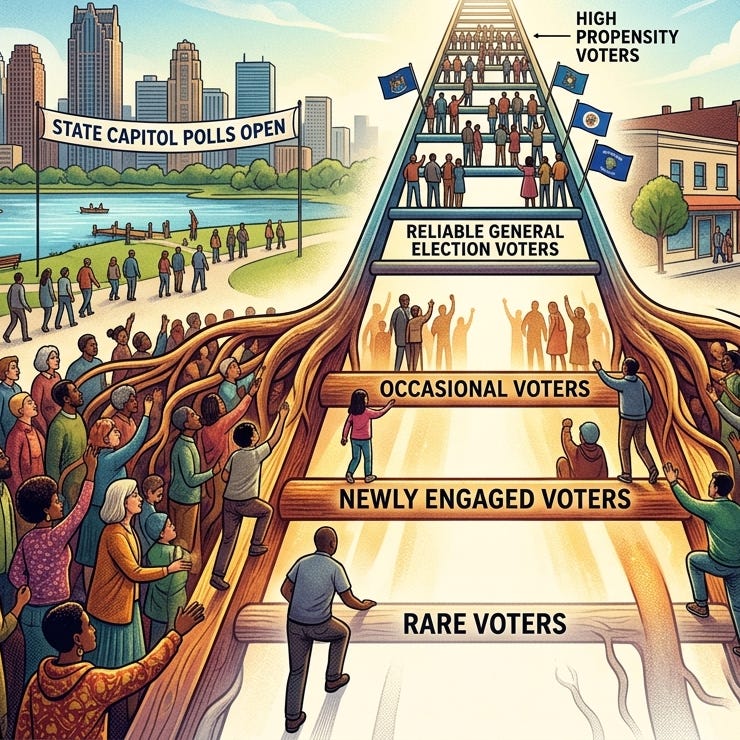
Think of voters on a ladder. At the top are obsessives who vote in everything from presidential races to the local school board. Below them are reliable general election voters. Further down are occasional voters who need a major catalyst.
At the bottom are registered ghosts who rarely vote at all. Campaigns and pollsters safely bet the house on the top rungs. But what happens when the ladder gets longer?
The Downward Expansion
That is the defining question of the 2026 primaries.
In Michigan, thousands of absentee ballots came from people who hadn’t voted in three election cycles. Minnesota’s million-plus turnout obliterates the tiny, predictable electorates that decide primary contests. Pundits lazily claim “young voters are turning out.” While youth engagement matters, data suggests a messier reality. The electorate isn’t just getting younger; it is drastically less predictable.
We aren’t just talking about 20-year-olds. We are talking about 45-year-olds and 65-year-olds who historically ignored primaries but suddenly decided this moment mattered. The electorate is expanding downward in voting propensity. People who don’t normally vote are voting. This leaves the polling industry flying blind.
When Likely Voter Models Break
Pollsters have always struggled to accurately predict the makeup of the electorate in traditionally low-turnout primaries, where predicting who will actually cast a ballot is an absolute guessing game. But they are having a particularly rough time this year because their traditional “likely voter” models—which lean heavily on prior turnout history—are completely fracturing.
When a massive wave of voters shows up who weren't adequately captured or weighted in pre-election survey samples, those historical filters collapse.
Because these unexpected demographics fall outside the pollsters' screening parameters, the surveys capture an inaccurate snapshot of the electorate, causing projected double-digit blowouts on paper to look wildly out of whack compared to what actually happened on voting day.
Volatility, Not Ideology
This brings us to the crucial lesson from Michigan and Minnesota: Beware the narrative that the Democratic base is uniformly marching to the progressive left.
Progressives scored major victories, but they didn’t run the table. This new electorate’s defining characteristic isn’t rigid ideology; it is extreme volatility.
The Democratic base hasn’t necessarily become more radical; it has become far more permeable. Voters who typically remain safely outside the primary bubble are now crashing the gates when a specific candidate or issue gives them a reason to care.
This creates a nightmare paradox for political consultants: A larger electorate makes an election inherently harder to predict. If only habitual voters participate, pollsters can lean on decades of historical data. We know who they are and how they behave. But when hundreds of thousands of irregular voters suddenly flood the zone, the old predictive formulas collapse.
The real question for 2026 isn’t whether turnout remains high. The question is: Who are these new voters?
If they are just habitual voters casting ballots early, the status quo holds. But if they are genuinely disengaged citizens being pulled into the fray, scrambling the political math, then we aren’t just watching an election. We are watching the electorate fundamentally rewrite its DNA. And for November, that unpredictable mutation matters far more than who won a mere handful of August primaries.